The founder “problem” in progressive organisations
It isn’t what you think. Founder syndrome gets blamed on founders, but there is a structural dimension to the conflict. Hint: it’s the board.
 Jack MilroyFounder, Fieldwork Advisory
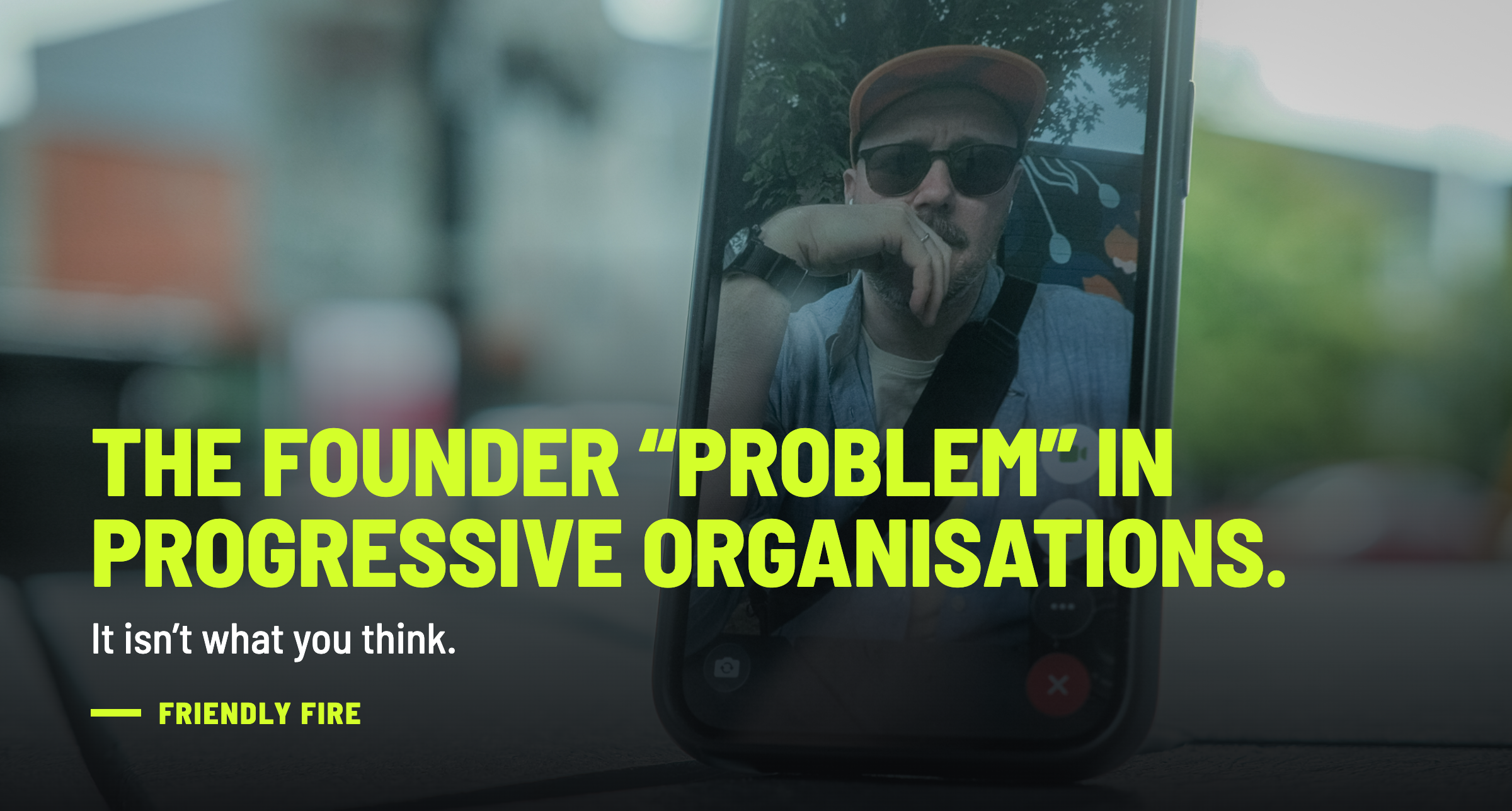
One of the great things about the global progressive movement is the number of new organisations that spring up every year. Many of these organisations are founder-led, meaning the founder is also the CEO or executive director.
We’ve all met founders we’d go to war for. And some we’d like to go to war with.
Clearly, there is a lot to appreciate in founders. A founder in this space typically begins with no funding, no permission, and little support. They also carry all the financial and political risk, and stand to bear any losses personally; not to mention the opportunity cost of pouring yourself into a project for years with no certainty it will work out.
But being a founder comes with a unique set of challenges. Often there are intertwined personal relationships throughout the organisation and network of funders. And the very same drive that propels someone to found an organisation is what makes it difficult to give up control over the day to day. What separates a mature, effective, founder-led organisation is the degree to which founders feel comfortable giving up some control over the small things, in order to focus on the larger mission.
I have some familiarity with the founder thing. My business is founder-led (me). And I founded Activate almost a decade ago, though now I cheer it on from afar rather than actively lead it. I have learned that there is often nothing between me and what I want to do. Good ideas, bad ideas, generally, I can just do them. There is no one to stop me.
This marriage of control and flexibility, sitting in the hands of one person, is both a source of strength and risk. Founders can act with speed, conviction, and a long time horizon. They can change course or even verticals without the bureaucracy of more mature organisations.
The challenge for founder-led organisations is that as they grow, their scale exceeds the founder’s sphere of attention. Decisions need to start being made by other people, and if the founder is not ready to cede power, this will inevitably lead to conflict, often derided as “founder syndrome”. When the founder makes no space for new energy, the organisation has a serious problem.
I’ve worked in and with a number of founder-led teams. I’ve supported executive directors and CEOs through some challenging transitions. I’ve come to believe that there is a structural dimension to the conflict. Hint: it’s the board.
Boards are meant to provide guidance and, crucially, accountability to CEOs. Often, however, the founder, who is also the CEO, recruited the entire board. It’s a classic board capture scenario. Founders recruit board members for their networks and for personal loyalty or relationships. Those board members then become reliant on the founder as CEO to provide the information they need to make their decisions.
The one real lever of accountability a board has over a CEO is the power to remove them. But in this cultural context, where the founder holds the relationships and the knowledge about the organisation, that lever is illusory. Our organisational model creates the conditions for “founder syndrome” by removing the ability of the board to hold founders accountable, and the ability of founders to receive direct and informed advice from their board.
In 1911 Robert Michels wrote about the Iron Law of Oligarchy. Studying the German Social Democratic Party, he said:
“Who says organisation, says oligarchy.”
He meant that every organisation, however democratic it intends to be, tends to drift towards control by a small group of people. Founder-led organisations should be particularly aware of this warning.
In my work with Fieldwork I have grappled with what the solution to this challenge is. I don’t think the fix is less founder authority. The benefits that founders bring are enormous. It depends, of course, on where the organisation is in its lifecycle, but diluting the vision and ability of the founder to act at speed can hobble an organisation just as the scale of our challenges is starting to exceed our capacity to respond.
When a founder is ready to recruit a board, they should start small and actively hold a few seats for people who are not from their direct network. Explicitly ask these people to hold you accountable. Write it into the bylaws. The founder could also work with an advisor to imagine where their founder energy best serves the organisation, and where they could delegate power and decision-making.
Boards and CEOs could develop a shared accountability matrix that is reviewed openly and quarterly. The number of founders and CEOs who don’t have clear and measurable goals, agreed with their board, is surprising. Clarifying roles, expectations and performance measures helps preserve a professional and collegial relationship by keeping everyone focused on strategic priorities.
The goal is to maintain the energy and dynamism that founder-led organisations had in their start-up phase, while also building systems that ensure accountability and clarity. This is in the interest of founders, boards, and the communities they exist to serve.
At Fieldwork I work on both sides of this: directly with founders and executive directors figuring out their approach to leadership, and with boards on the structures that let an organisation keep growing and stay aligned and energised.
Two decades convening and advising progressive leaders across Australia, Canada and the US. If this piece describes your campaign, a Campaign Review is the fastest way to test it.
Book a Campaign Review →